

In a nutshell
Dedicated addresses allow you to create unique blockchain addresses for each customer. These addresses can receive stablecoins across multiple EVM-compatible chains, with deposits automatically swept to your master wallet.
Dedicated addresses allow you to create unique blockchain addresses for each customer. These addresses can receive stablecoins across multiple EVM-compatible chains, with deposits automatically swept to your master wallet.
Prerequisites
Before generating addresses, ensure you have:1
API Key
Get your API key from the Blockradar Dashboard. Navigate to Developers to generate one.
2
Master Wallet Created
Create at least one master wallet in the dashboard (see Create a Master Wallet). You’ll need the
walletId to generate addresses.3
Wallet Funded
Fund your master wallet with native tokens (ETH, BNB, MATIC, etc.) to cover gas fees for auto-sweeping operations.
4
Webhook Configured
Set up your webhook URL on the master wallet to receive deposit notifications. See Webhooks for setup details.
How It Works
Dedicated Addresses is a crucial feature on Blockradar that enables you to create unique addresses for your customers. These addresses allow your customers to deposit stablecoins into your fintech app seamlessly. When you create a dedicated address for a customer, they can use that single address to deposit stablecoins across multiple EVM-compatible blockchains. For example, if you have Ethereum, Binance Smart Chain, Polygon, and Base master wallets created, each address you generate through any of these master wallets can be used to receive stablecoins on any of the supported blockchains and assets. This ensures that you don’t have to worry about your customer sending stablecoins to the wrong blockchain. Additionally, when stablecoins are deposited into a particular address, the assets are automatically moved to the chain’s master wallet address.Aside from Tron and Solana, addresses generated from one wallet can be used to deposit stablecoins across other blockchains that have the blockchain parameter
isEvmCompatible: true.Creating addresses on Stellar, Tron, or Solana? These networks require accounts to be activated or hold minimum balances before they can receive assets. On Stellar, each new address is automatically funded from your master wallet with 1 XLM plus 0.5 XLM for each asset enabled on the wallet — this is the network’s required reserve, not a fee. See Address Activation for what to expect on each chain.
Address Parameters Explained
When creating or updating an address, you can use the following optional parameters to customize its behavior:Notes:
- All these parameters are optional; you only need to include those relevant to your use case.
- Enabling
showPrivateKeycan expose sensitive information. Only use this in secure, trusted environments. - Be cautious with
showPrivateKeyexposing private keys can compromise security.
Create a Dedicated Address
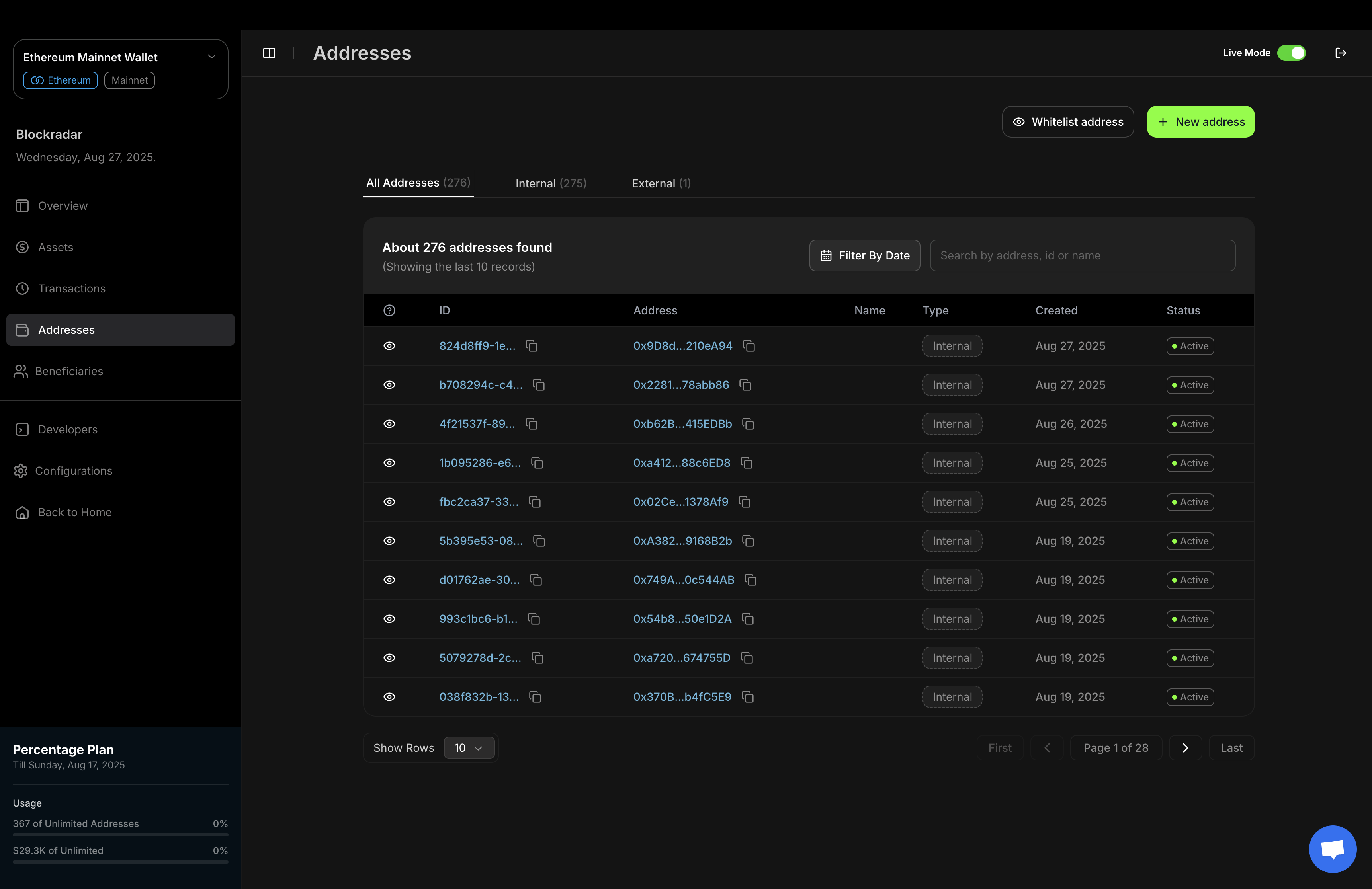
You can generate a dedicated address for your customer using either the Blockradar dashboard or the API, depending on your workflow and integration needs.1. Using the Dashboard
The Blockradar dashboard provides a simple, user-friendly interface for generating new addresses.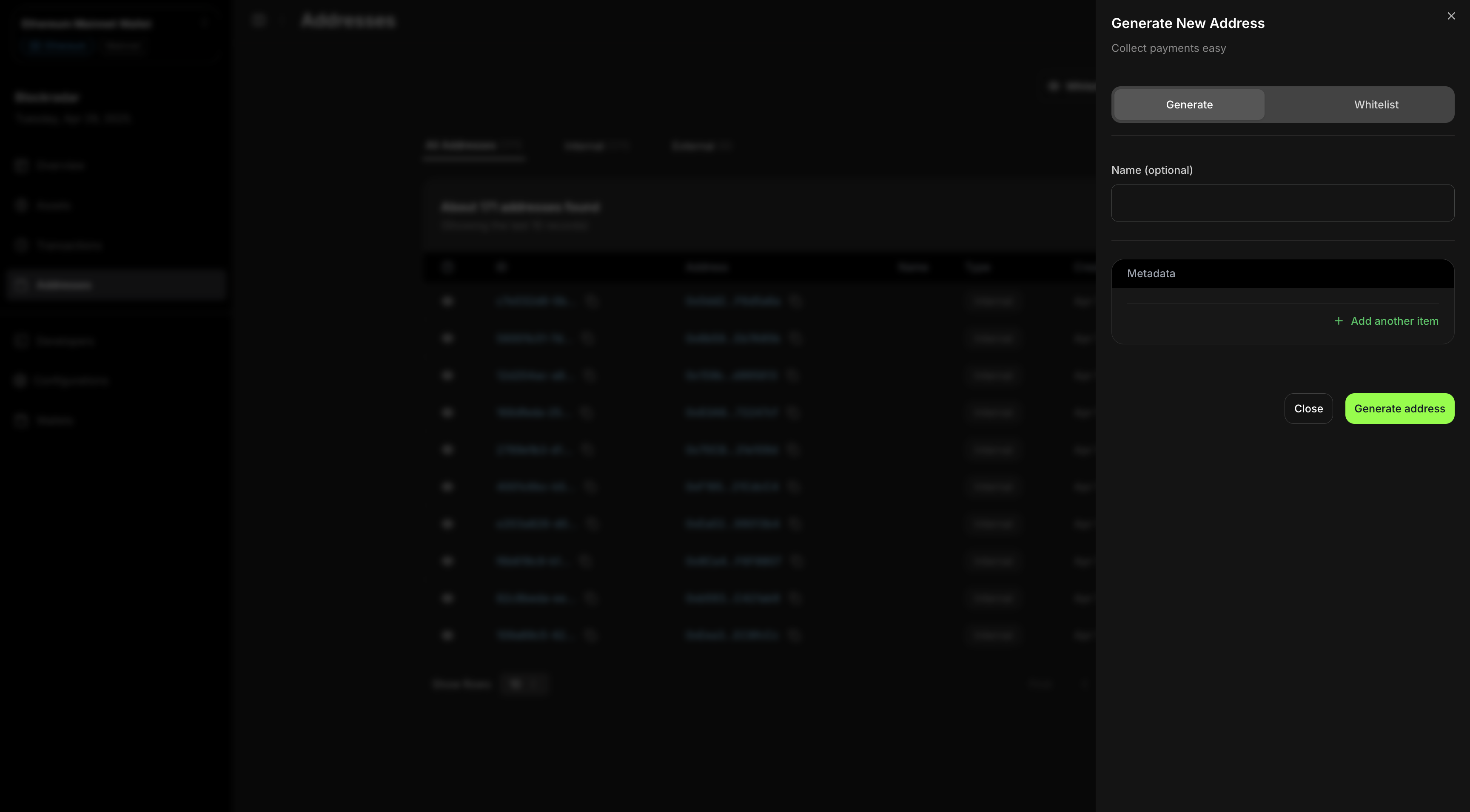
This screenshot demonstrates the process of generating a new address via the Blockradar dashboard. This method is ideal for manual address creation or for teams who prefer a graphical interface.
2. Using the API
For programmatic or automated address generation, you can use the Create Dedicated Address API.This is useful for integrating address creation into your own applications or backend systems. To create a dedicated address for a customer, send a
POST request to our Create Dedicated Address API.
Response
Address Issuing and Indexing
Blockradar separates two things that used to happen together when you create an address:- Issuing an address is cheap. It derives a new address from your master wallet and stores it, so you can hand it to a customer right away.
- Indexing an address is the costly part. It places the address under on-chain monitoring so deposits are detected in real time, and indexing is what billing is based on.
Two independent switches
Every address has two settings that control its state:
An address is watched on-chain and counted for billing only when both are on:
isActive: true and indexingStatus: ACTIVE.
Existing addresses are unaffected.
indexingStatus defaults to ACTIVE, so every address you already created, and every address you create without opting in, behaves exactly as before.Issue a dormant address
When generating an address, passenableIndexing: false to create a dormant address that is not watched and not billed. Omit the field or pass true for the default behavior (indexed immediately). A dormant address returns "indexingStatus": "INACTIVE" in the response.
Enable indexing
Enable indexing when the customer shows intent to deposit. This subscribes the address, starts real-time monitoring, and includes it in billing. The call takes no body and is idempotent (a no-op if indexing is already on). TheaddressId path parameter accepts either the address UUID or the on-chain address string.
The response shows "indexingStatus": "ACTIVE". It returns 400 if the address has been deactivated (isActive: false).
Disable indexing
Disable indexing for churned or inactive customers to stop billing for addresses you no longer watch. This stops monitoring and removes the address from billing on the next cycle. The call takes no body and is idempotent. Funds already received remain safe on-chain, and you can re-enable indexing later at no extra cost beyond normal billing. The response shows"indexingStatus": "INACTIVE".
Billing
Address billing is a live count taken at each renewal, not a per-address charge. Each cycle, Blockradar counts the addresses that are active and indexed on mainnet and charges for usage above your plan limit.
Generating dormant addresses bills nothing, and disabling indexing reclaims that slot on the next cycle.
Best practices
- Issue a dormant address when you assign it to a customer. It costs nothing.
- Enable indexing when the customer shows intent to deposit (KYC passed, checkout opened, deposit screen viewed).
- Always enable indexing before sharing an address for a real deposit, so the deposit is detected in real time.
- Disable indexing for churned or inactive customers, then re-enable later when needed.
Address Whitelisting
This feature allows you to whitelist an external address to be monitored based on the wallet’s requirements. Already have wallets issued by another provider? You can still plug them into Blockradar and monitor deposits without changing your existing setup.Body Parameters
Response
Testing
Addresses generated via a testnet master wallet can only receive assets on the testnet.
- Ethereum - Get test USDC here: Circle
- Binance Smart Chain - Get test USDT here: Binance
- Polygon - Get test USDC here: Circle
- Base - Get test USDC here: Circle
- Tron - Get test USDT here: Nileex
- Solana - Get test USDC here: Circle
- Optimism - Get test USDC here: Circle
- Arbitrum - Get test USDC here: Circle
- Celo - Get test USDC here: Circle
Happy hacking! 💚